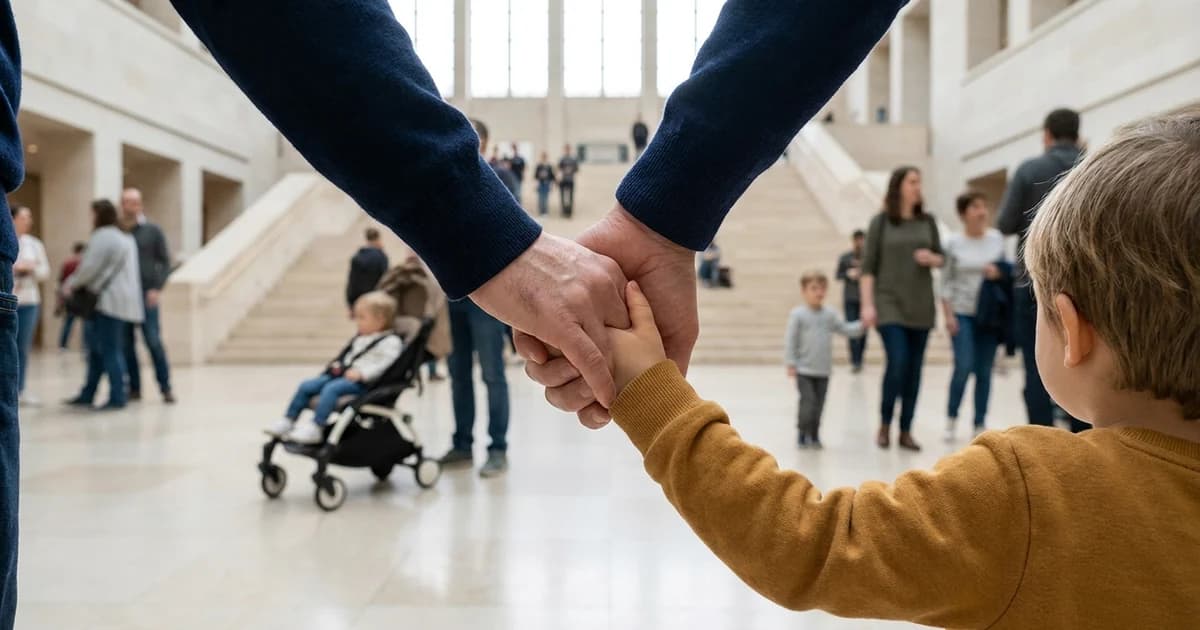
The waiting period is television, not law
Almost every parent carries the same folklore: nobody takes a missing child seriously until twenty-four hours have passed. It is among the most durable false beliefs in American life, and the passage that kills it is short enough to say out loud at a counter.
Two hours is the legal clock. Most separations end in four minutes, with a child two aisles away looking at something shiny. This is about the gap between those numbers — and about the part the advice columns skip: minute one is genuinely different in a museum, a theme park, a ship and a foreign city, because the duty attached to where you stand is different in each.
The first fifteen minutes, in order
The usual failure is not doing the wrong things. It is doing them in the wrong order — burning eight minutes searching privately before telling any staff member.
Stop moving and split the adults
One adult stays planted exactly where the child was last seen, because a child who doubles back needs a parent there rather than an empty space. Everyone else takes a named assignment: nearest exit, the thing your kid was excited about, the toilets.
Tell the nearest uniform, and say "missing child"
Staff escalate on vocabulary. "I've lost my son" collects sympathy; "my child is missing" starts a procedure. Give the age in the same breath and point at the door you want watched.
Call the police without asking permission
You do not need the venue to agree. NCMEC tells families to call local law enforcement immediately, then NCMEC on 1-800-843-5678. That order is deliberate — the police report starts the database clock.
Ask, out loud, for the NCIC entry
NCMEC's instruction is to request that officers immediately enter the child's details into the FBI's National Crime Information Center Missing Person File. Naming the database removes ambiguity, and it is the record the two-hour rule means.
Hand over this morning's photograph
Not a school portrait from last spring. Today's clothes, today's hair, today's shoes — for a reason more technical than sentimental.
The morning photo is a legal checklist
The Code Adam Act of 2003 specifies what security staff must collect before they can act: name, age, eye and hair color, height, weight, clothing, and shoes. Read that as a photographer rather than a lawyer. One picture taken at breakfast answers six of those seven fields instantly — at the moment a frightened parent's memory of what their child put on is at its worst.
- What parents usually buy: a wristband with a phone number, a bright shirt, a tracker in a pocket.
- What actually shortens the search: a photo from this morning, a rehearsed meeting point, and a child who can say a parent's full name.
Who owes you what, by venue
| Where you are | What is required or published | Tell first | Ask for it by name |
|---|---|---|---|
| Federal building or museum | Code Adam is mandated by statute | Building security | A Code Adam |
| Store or mall | Voluntary; NCMEC notes many stores keep a plan | The store manager | The exits, covered now |
| Theme park | Operator's own. Disney World publishes that a separated child goes to a Baby Care Center | Nearest staff member | The reunion point |
| Airport terminal | The no-waiting-period rule applies; airport police hold jurisdiction | Airline staff, then airport police | Exit cover and the NCIC entry |
| Cruise ship at sea | The operator must phone the FBI as soon as possible | The ship's security office | The vessel's security guide |
| Outside the US | Local police lead; the embassy works with them | Local emergency number | The embassy duty officer |
Code Adam is mandatory in one kind of building only
The Act defines a public building as one owned or leased for use by a federal agency, and names who is responsible: the General Services Administration for most, the Board of Regents for the Smithsonian. If your day involves the museums on the National Mall, you are in the one category where this is a legal obligation rather than a courtesy. The statutory floor is eight steps:
- Notify security a child is missing.
- Take a description, down to shoes.
- Issue the alert fast and effectively.
- Establish a central contact point.
- Monitor every exit while it runs.
- Search the building thoroughly.
- Contact local police.
- Document the incident.
At sea the answer is written down, and nobody reads it
Passengers assume a missing person at sea falls into a jurisdictional void. The opposite is true. Under the passenger vessel security and safety requirements, the owner of a covered vessel must phone the nearest FBI field office or legal attache as soon as possible after a missing United States national is reported.
Abroad, the American machinery stays home
This is what catches families out on a first international trip. The two-hour rule binds US states. NCMEC's hotline is American, and its own guidance sends callers outside the country to their national hotline. The AMBER network is US infrastructure. None of it follows you to Lisbon.
An AMBER Alert is a different tool
Parents sometimes ask why no alert went out. The Justice Department's recommended criteria are narrower than the public assumes, and all must be met:
- Police reasonably believe an abduction occurred.
- The child faces imminent danger of serious injury or death.
- There is enough description to be worth broadcasting.
- The child is aged 17 or younger.
- The details, with the Child Abduction flag, are already in NCIC.
The official guidance is explicit that activating without significant information that an abduction occurred would weaken the system. A child who wandered off in a crowd is not an AMBER case. The NCIC entry, not the broadcast, is what to push for.
The one answer you can only get on the ground
We went looking for published lost-child procedures across the venues families actually visit. Disney World's is the only major theme-park one we could verify from the operator's own site — and its Baby Care Centers sit in the four theme parks, not the water parks, the hotels or Disney Springs. Which makes the last piece of preparation a question rather than a purchase.
Five minutes on the first morning
- Take the photo. Full length, today's clothes, before leaving the room.
- Name the meeting point. Something a child can find alone and describe to an adult.
- Ask where lost children go at the first staffed desk, and tell the kids the answer.
- Rehearse the script. Find a staff member or a parent with kids; say a parent's full name, not "Mommy".
None of this argues for travelling less — it is the logic behind reading up on beach and ocean safety before a first coastal week. And if you hoped a tracker covered it, our read on what AirTags do and do not do is the companion piece: they are luggage tools, and a missing child is a people problem with a legal answer.