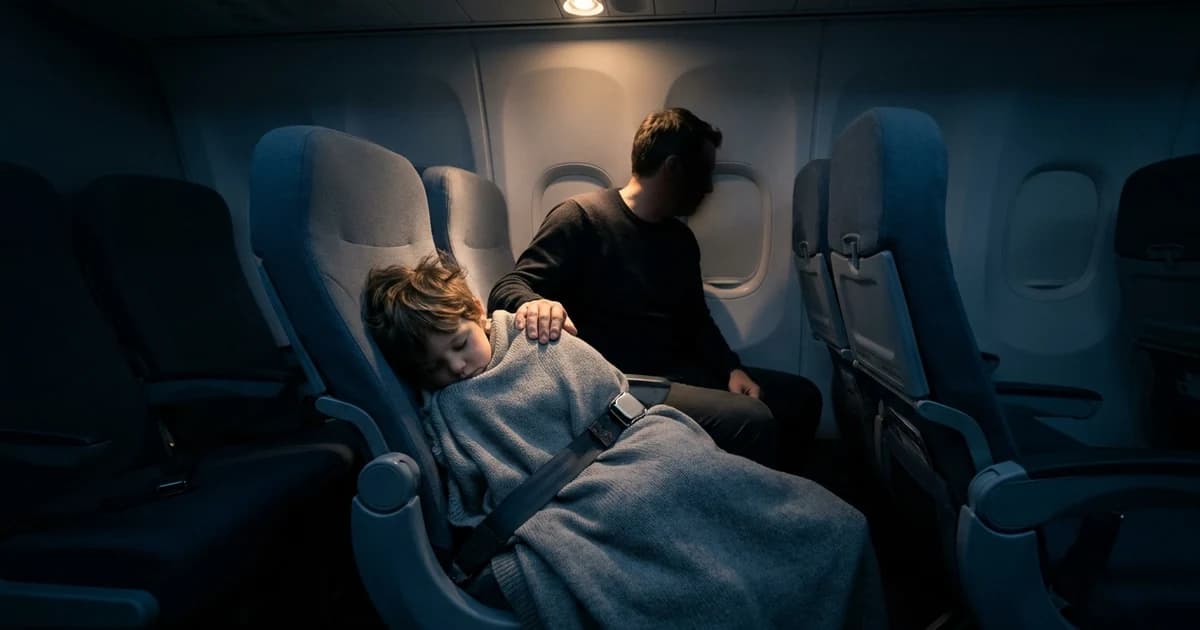
The device is not the decision. The seatbelt sign is.
Every "how to get kids to sleep on a plane" list is really a shopping list: an inflatable box for the footwell, a hammock that clips to the tray table, a neck pillow shaped like a horseshoe. Almost none of them mention the rule that decides whether any of it works. On every airline we could verify, a sleep device that is permitted at all is permitted only while the seatbelt sign is off. The moment it comes on, the thing has to come out from under your sleeping child.
What the airlines actually say
We read each carrier's own published policy rather than the secondhand lists circulating on family-travel sites, and two of those lists are wrong. British Airways is widely reported as banning inflatable sleep devices; it publishes a named approved list. Air Canada is widely reported as banning the BedBox; its own page permits BedBox-type beds with conditions while banning hammock seats outright.
| Airline | In-seat bed (BedBox / Plane Pal type) | Hammock or foot sling | The condition that matters |
|---|---|---|---|
| Delta | No. Inflatable wedges, cubes and beds prohibited; the children's page names the Fly Tot and Flyaway Kids Bed | No | Comfort items must fit carry-on limits and collapse fast |
| British Airways | Yes, from a named list: Flyaway Kids Plane Bed, Plane Pal, Jet Kids Bed Box, Travel Snug, Kooshy Kids Kushion | Not listed, so not permitted | Window or centre seat only; the Bed Box cannot be used during turbulence |
| Air Canada | Yes, with conditions: "infant beds similar to Flyaway Kids Bed, BedBox" | No. Fly LegsUp and Flyebaby named as prohibited | Must not block the aisle; stowed whenever the seatbelt sign is on |
| Singapore Airlines | Yes, with a purchased seat: "inflatable flight cushion or convertible gadget" | No. Seat extenders and foot hammocks not allowed | Child must fasten the belt under their arm; stowed for taxi, take-off and landing; 115cm total |
| Qantas | No. Inflatable cubes and "bed boxes" named | No. "Leg hammocks" named | The list is explicitly not exhaustive; crew decide on anything else |
| American | No published position we could verify | No published position we could verify | Publishes a restraint approval list only. Check with the airline |
| United | Could not verify | Could not verify | No readable policy page. Check with the airline |
Two rules underneath all of it explain almost every "why is this banned" question:
- Nothing may block an escape path. Aisles, exit rows and footwells are evacuation space, which is why the same product is fine in a window seat and forbidden one seat over.
- Nothing may attach to the aircraft. British Airways states that no item may be attached to your seat, including the tray table and armrests. That removes every clip-on hammock.
What works, by age
The right answer changes completely across about eight years of childhood, and most gear guides average them into one useless recommendation.
Lap infant, under 2: the bassinet, and how narrow its window is
The bulkhead bassinet is the only genuinely flat bed a non-ticketed baby gets, and it expires early. The American Academy of Pediatrics notes most airlines offering bassinets require babies to be under six months or 20 pounds and not yet sitting up unaided. A rolling ten-month-old is usually out.
- Request it at booking, not at the gate. There are only a handful of bassinet positions per aircraft.
- Expect to lift them out repeatedly. The AAP is explicit that a baby must be buckled into a car seat or held during take-off, turbulence and landing.
- Keep it bare. Firm and flat, no loose blankets, pillows or stuffed animals, exactly as at home.
Car seat age, roughly 1 to 4: the car seat is the sleep gear
Here the gear question answers itself. A car seat is reclined, has side wings the head can fall against, and is approved for every phase of flight. No inflatable box does any of those three things, and it also solves the arrival-day problem covered in whether you need a car seat on a plane.
- Check the label. It must read "certified for use in motor vehicles and aircraft," or carry an equivalent foreign approval marking.
- Window seat. A rear-facing seat in an aisle blocks other passengers' exit and airlines will move you.
- Backless boosters are out. The FAA prohibits boosters and backless restraints during taxi, take-off and landing.
Once a child outgrows the harness, the FAA-certified CARES harness takes over: approved for 22 to 44 pounds and up to 40 inches, and legal for taxi, take-off, landing and turbulence.
The gap years, roughly 4 to 7: the problem is the footwell
This is the band the whole product category was invented for, and the band where policy is most likely to stop you. The child is too big for a car seat and too small for the seat: their legs end halfway along the cushion, so their weight hangs from the backs of the knees and they slide down whenever they lean back.
- If your carrier allows a bed, book the window seat. Every permitting policy we read restricts in-seat sleep devices to window or centre seats.
- If it does not, raise the feet instead. A soft cabin bag in the footwell fills the same gap, packs flat, and no policy prohibits it.
- Take the middle only if you have the window. British Airways requires the window passenger to be in your party for exactly this reason.
Eight and up: this is when a neck pillow finally earns its space
By now the shoulders reach the seat back and the head clears the headrest, which is the geometry a U-shaped pillow was designed around. This is also the age where the useful lever stops being gear and becomes timing: meal early, screen off, descent treated as the wake-up rather than a surprise. Our long-haul flight guide and the jet-lag piece both work that lever.
Why a neck pillow is the wrong shape for a five-year-old
We found no published testing on this, so treat it as reasoning rather than a finding. A neck pillow works by filling the space between an adult's shoulder and jaw so the head cannot tip far, and its opening is sized for an adult neck. On a five-year-old that opening swallows the neck, rides up around the ears, and braces nothing.
The bigger issue is what a young child's slump actually looks like. Their torso is short relative to the seat back, so the head sits below the headrest rather than against it, and they rarely tip sideways into a pillow at all. They fold forward at the waist, or slide down into the armrest. A ring around the neck addresses neither motion.
The plan that survives contact with the seatbelt sign
- Confirm the operating carrier's policy and screenshot the page before you pack anything inflatable. Crew discretion is real, and a screenshot is a better conversation than an argument.
- Book the window seat for whoever is sleeping. It is the only seat where every permitted device is actually permitted, and it removes cart wake-ups.
- Assume two interruptions. Rehearse the deflate-and-stow as routine, not emergency, and they are far more likely to go back down.
- Bring the one thing nobody confiscates: a familiar blanket or comfort object. It survives every policy, aircraft and crew.
Airlines have been narrowing what is allowed and the products have not caught up. Under two, buy the seat and bring the restraint. Four to seven, check the policy first and pack a soft bag as the fallback. Eight and up, stop buying gear and manage the clock. For the awake hours, our screen-free entertainment guide takes over.