Trtl draws the line at eight
Search the Trtl travel pillow and you get the brand's own store, a wall of Amazon listings, and a lot of adults arguing about whether it works with over-ear headphones. Almost nobody answers the question a parent actually has, which is whether the thing fits a child at all.
That reframes the purchase: the Junior is not a toddler product with a cute name, it is a smaller adult product with a lower age floor.
Junior vs Original, in Trtl's own numbers
| Spec | Pillow Junior | Travel Pillow (Original) |
|---|---|---|
| Stated age | 8 and up | 14 and up |
| Dimensions | 7.5 x 8.7 x 3.6 in | 8.7 x 9.5 x 3.6 in |
| Weight | 3.9 oz | 4.7 oz |
| Trtl list price (its own store, October 2026) | $44.99 | $54.99 |
| Own-site rating | 4.8 from 202 reviews | 4.7 from 1,676 reviews |
The gap is small in inches and large in fit: the Junior shortens the rigid support so it sits under a shorter jaw. Trtl sells the two together as a parent-and-child All Aboard bundle.
It is a brace in a scarf, not a pillow
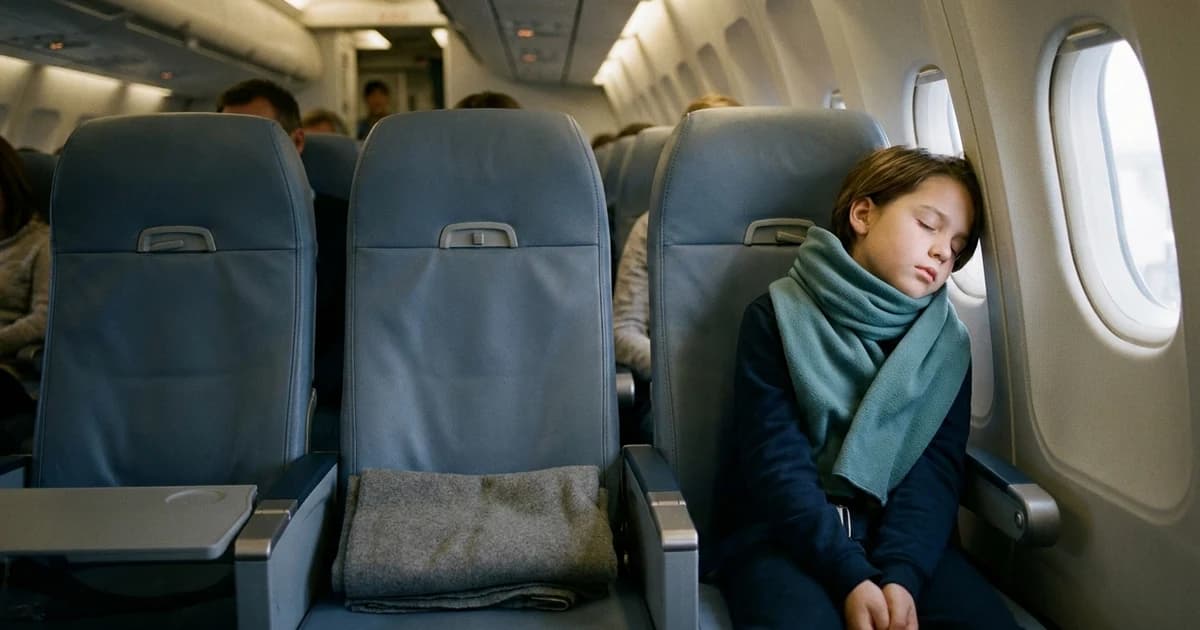
This is the part that decides whether it suits your kid, and the photos hide it. There is no foam doughnut inside: a curved rigid support wrapped in fleece, and a long scarf that winds round the neck to hold it against one side of the jaw.
- What it does well: stops the slow forward chin-drop, keeps the head off a neighbour's shoulder, packs to a third of a U-shaped pillow's bulk, washes.
- What it cannot do: support a head that flops the other way without being unwound and rewrapped, which means waking up to change sides.
Owners in a long r/TravelHacks thread land on the same three notes, and each matters more for a child than an adult: repositioning means fully waking, over-ear headphones and the pillow rarely coexist, and the fleece runs warm in a full cabin. None of it is fatal. All of it is worth knowing before spending $45 to $55 on a nine-year-old who has never worn one.
Most Junior buyers are not children
Trtl asks its reviewers a question almost no brand asks, then publishes the answers: was this bought for a child? We pulled all 202 Junior reviews from Trtl's store and counted.
It is the most useful fact about this product and it appears nowhere in the search results. Read it two ways. The Junior is a genuinely well-fitting small pillow rather than a toy, which is reassuring. But the glowing average is mostly adults rating an adult experience: the parent reviews are positive and mention children of six, ten and eleven, yet 18 is a thin sample of people who had already chosen to buy.
Which one fits, by age and height
| Your traveller | Trtl's line | Our call |
|---|---|---|
| Under 5 | Nothing offered | Skip. Timing beats any device |
| 5 to 7 | Below the stated floor | Skip. Shoulders miss the seat back |
| 8 to 13 | Junior | Junior, tried at home first |
| 14+, under 5 foot 3 | Either | Junior, judged on neck length |
| 14+, taller | Original | Original |
The deciding variable at the bottom of that table is neck length, not age. A short-necked fifteen-year-old is a Junior customer; so is a 5 foot 1 adult.
Under eight, the honest answer is that the lever is not gear. Our guide to getting kids to sleep on planes works through it age by age; the short version is that seat choice and departure timing outperform anything you can buy. A tired child with a window to lean on out-sleeps a well-equipped one in a middle seat.
Not in a car seat, and not on a toddler
Parents reach the same conclusion without the citation. In an r/toddlers thread about a gifted neck pillow the consensus was near-unanimous: fine on the sofa, fine for pretend play, not in the car seat, and cut the fastener off. Several made the sharper point too, that the slumped car-seat head bob it was meant to fix is uncomfortable to look at rather than uncomfortable to have.
The restriction follows a child onto a plane whenever they ride in an approved restraint, which the NTSB still urges for every child under two rather than a lap hold that cannot survive turbulence. We cover that decision in whether to bring a car seat on the plane.
What "scientifically proven" actually rests on
Trtl markets patented, scientifically proven neck support, and it does name a source. Its science page credits work with the University of Dundee, led by an orthopaedic professor, using motion analysis in a simulated cabin, in which 124 of 126 participants preferred the Trtl to a U-shaped foam pillow.
The limits deserve the same plainness. The citation is an undated in-house case study, not a journal article, and we could not find it indexed in the biomedical literature. It compares the pillow against one alternative, and every participant was an adult. There is no published testing of this design on children, so treat the eight-and-up floor as a manufacturer's sizing judgement, not a safety finding.
Trtl vs J-Pillow for kids
The J-Pillow is the other chin-support pillow parents compare, and the two makers take opposite approaches. Using only what each one publishes:
| Trtl Pillow Junior | J-Pillow | |
|---|---|---|
| Stated age | 8 and up | None stated; J-Pillow says one size fits all |
| Kid size? | Yes, a shorter version of the Original | No separate kids' version on J-Pillow's site |
| Build | Rigid curved support inside a fleece scarf | Soft, springy polyester-fibre fill with a chin support that curls under the chin |
| Weight | 3.9 oz | Around 12 oz |
For a child, that difference matters more than the brand. Trtl sizes the Junior for a smaller jaw and says plainly where it stops; J-Pillow designs one size around adult head-to-chin ratios and publishes no child guidance, so there is no maker's word on how it fits a child. The J-Pillow is softer and does not rely on a rigid brace, which some kids will tolerate better; the Trtl weighs about a third as much. Neither maker sells anything for under-8s, and the safety section above applies to both: neither belongs in a car seat. We link no J-Pillow listing here because we have not verified one.
When no pillow is the better answer
Buying nothing is a legitimate outcome, and on a lot of family trips it is the right one.
- Flights under about four hours. Not enough sleep window to justify carrying it.
- A child who refuses things on their body. If hats, seatbelt covers and hoods come off, this will too.
- An aisle or middle seat. One-sided support wants a wall; without one the head still tips outward.
- Kids who sleep in over-ear headphones. Pick one; owners report the two do not combine, and headphones usually win.
- Anything under eight. Put the money into a better boredom plan and an earlier bedtime the night before.
If you do buy, buy it a fortnight early and make them wear it on the sofa. The Trtl is not intuitive; it takes two or three goes to find the right wrap tension, and a midnight cabin is a poor place to learn. Trtl's 100-day return window makes that test free.