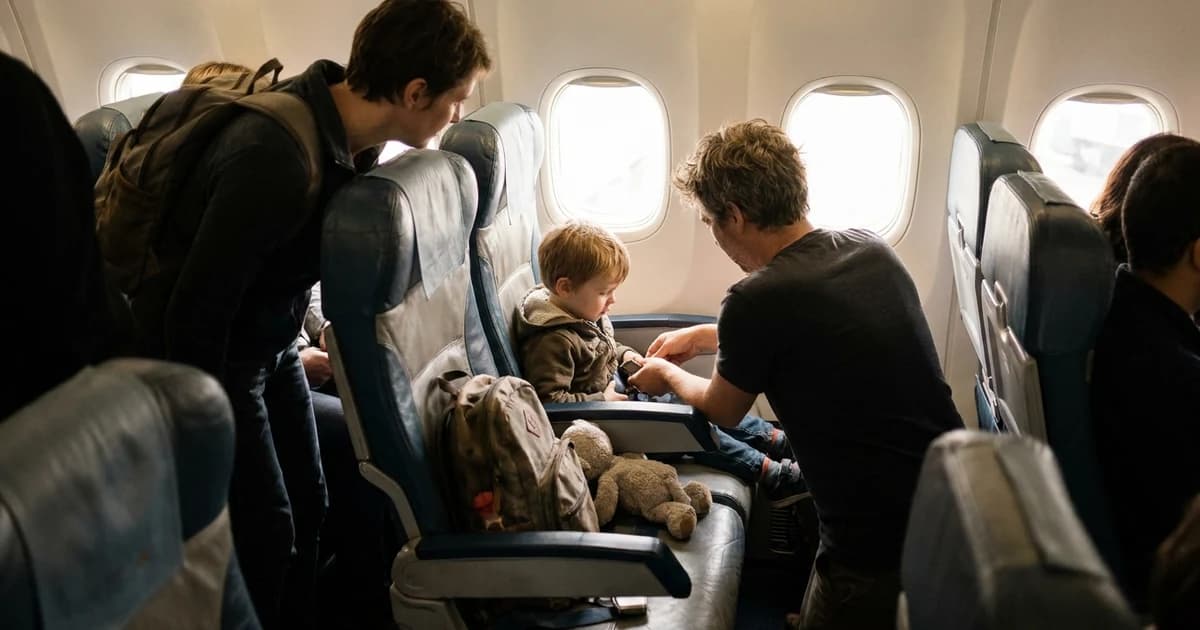
Every family-seating guide ranks airlines by who "guarantees" your kids a seat next to you. Read the federal fine print behind that word and the guarantee turns out to have an off switch, and the family holds it: pick seats for some of the party and not the rest, and the airline is allowed to walk away from its promise. That one booking habit matters more than which carrier you fly.
Five airlines commit, four only try
The Department of Transportation keeps a family seating dashboard that records one thing per airline: whether it guarantees a child 13 or under a seat next to an accompanying adult, at no extra cost, on every fare type. Here is how the nine airlines it covers stand.
| Airline | Fee-free seat next to a child 13 or under? | What that means at booking |
|---|---|---|
| Alaska Airlines | Guaranteed | Free, if you meet the conditions below |
| American Airlines | Guaranteed | Free, if you meet the conditions below |
| Frontier Airlines | Guaranteed | Free, if you meet the conditions below |
| Hawaiian Airlines | Guaranteed | Free, if you meet the conditions below |
| JetBlue Airways | Guaranteed | Free, if you meet the conditions below |
| Allegiant Air | No commitment | May mean paying for seat selection |
| Delta Air Lines | No commitment | May mean paying for seat selection |
| Southwest Airlines | No commitment | See the January change below |
| United Airlines | No commitment | May mean paying for seat selection |
A "no" does not mean those airlines split families as a matter of course. It means they have not given DOT the unconditional promise, so a seat next to your child is something you may have to buy.
The guarantee comes with an off switch
DOT lets a guaranteeing airline attach five conditions to its promise. In plain terms, the guarantee holds only if:
- The child and the adult are on the same reservation.
- Adjacent seats are still available when you book, in the cabin you bought.
- The airline does not swap in a smaller plane.
- The adult picks seats for the whole reservation or skips them for the whole reservation, and does not change them once assigned.
- The seat layout physically allows that many children to sit beside their adults.
Three of those are out of your hands. The fourth is entirely in them, and it is the one families trip over: you pay to choose two good seats, leave the kids' seats for later, and you have just stepped outside the guarantee. American states the same rule in its own words on its traveling-with-children page: choose seats for the entire family or skip seats for that flight, because skipping beats choosing just a few.
Keeps the guarantee
- Everyone booked on one reservation, in one transaction.
- Seats chosen for every traveler, or for none.
- Leaving assignments alone once the airline sets them.
Lets the airline off the hook
- Kids on a separate booking, or a grandparent booked later.
- Buying good seats for the adults and "sorting the kids out" later.
- Moving one person after assignment to chase a window.
Southwest changed the math in January
Southwest's old open seating let families board early and grab a row. That ended with assigned seating on flights from January 27, 2026. Its family seating policy now reads differently from the five guarantors:
- Southwest says it will "endeavor" to seat a child 12 and under next to one accompanying passenger 13 or older, to the extent practicable, at no extra cost. That is effort language, not a guarantee, and DOT's dashboard page says outright that statements about making efforts do not satisfy it.
- On Basic fares, seats are assigned at check-in, which opens 24 hours before departure. Southwest itself steers families toward Choice fares or paid seats at booking.
- If your child is not seated next to you, ask a gate agent first. When no adjacent seats exist on your flight, Southwest says the agent will offer to move you to the next available flight that has them. Useful on a Tuesday, less so on the last flight before Thanksgiving.
"Child" means four different ages
Parents of a 13- or 14-year-old should read the age line in each policy, because no two sources draw it in the same place.
| Source | Who counts as a child for seating |
|---|---|
| DOT dashboard and the 2024 proposed rule | 13 and under |
| FAA Reauthorization Act of 2024, section 516 | Under 14 |
| American Airlines | Under 15 |
| Southwest Airlines | 12 and under (13 and under on Basic fares bought by December 17, 2025) |
The federal rule is still a proposal
None of this is required by regulation yet. In August 2024 DOT proposed a rule requiring US and foreign airlines to seat children 13 and under next to an accompanying adult at no cost beyond the fare, with civil penalties per child when they fail. The most recent regulatory agenda entry we could read files it under long-term actions, with the next action undetermined.
One detail worth watching
The 2024 FAA law that ordered DOT to write this rule protected airlines with open or flexible seating from having their seating model changed. Southwest no longer has open seating. If the rule is ever finalized, that carve-out no longer describes the airline it most obviously fit.
Until then the dashboard is a list of voluntary commitments, and the law that requires DOT to publish it (49 U.S.C. 42308) expires on October 1, 2028.
Book it right the first time
- Put every traveler, kids included, on one reservation.
- Book early: adjacent seats have to exist when you book for any guarantee to apply.
- Choose seats for everyone or for no one. Never half.
- On Delta, United, Allegiant or a Southwest Basic fare, decide up front whether a seat beside a young child is worth paying for. On a holiday flight it usually is.
- Check your seats when check-in opens, and raise a split with the gate agent before boarding starts, not on the plane.
- If an airline breaks a published commitment, file a complaint with DOT as well as with the airline.
Once the seats are sorted, the rest of the airport is the easy part: how to gate-check a stroller, whether a car seat needs its own ticket, and our tips for flying with a toddler.