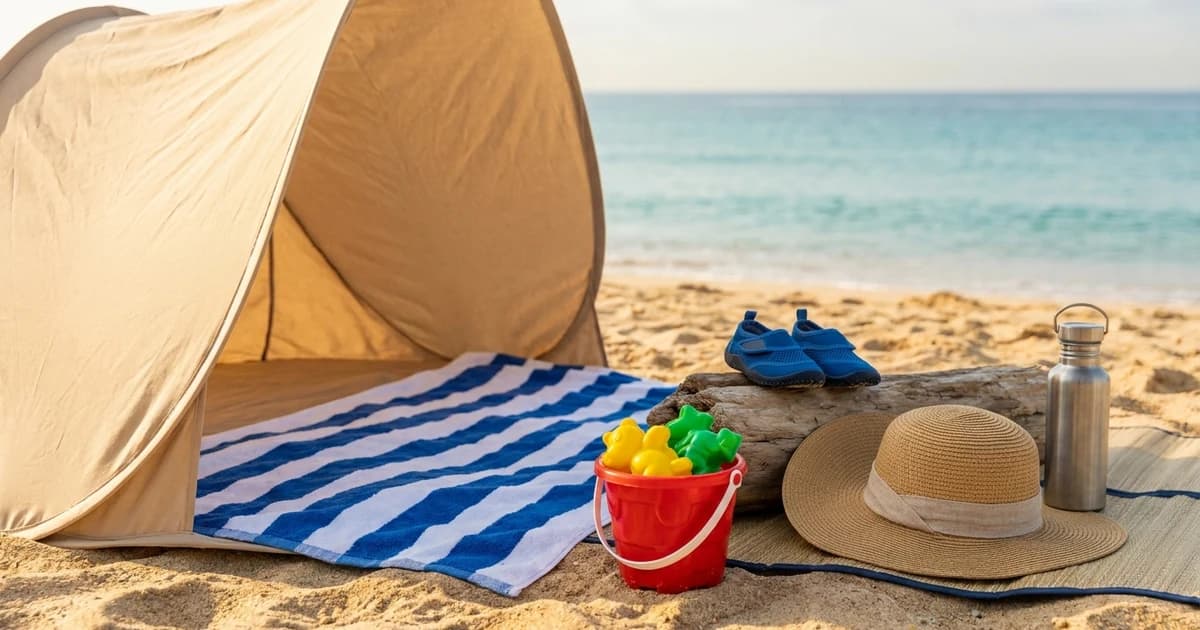
The part everyone forgets
Families pack the beach or pool day like it's all swimming. Swimsuits, towels, sunscreen, goggles — done. But a real beach day isn't six straight hours in the water. Kids come out cold, get sunburn-tired, refuse the next dip, and then it's 2 p.m. on the sand with a bored, pink, gritty child and nothing to do. The non-swimming hours are the part that breaks a beach day, and they're the part most packing lists ignore.
This is a small kit — not a second suitcase — chosen to cover the timeline of an actual family beach or pool day. Pack for the gaps between swims, and the whole day holds together.
Key takeaways
- Pack for the dry hours, not just the water. Kids spend half a beach day out of the water; that's the half that needs gear.
- Foot protection earns its space first. Midday sand and pool decks get hot enough to hurt, and water shoes also handle rocks, shells, and hot ladder rungs.
- One small screen-free toy beats a tablet at the pool. Sand and water kill tablets fast, and unstructured play is genuinely better for young kids than a screen.
- Have a rain and rest-hour backup. The toy that travels best is the one that also works in the hotel room when the weather turns.
Water hours: the gear that goes in the water
This part most families get right, so keep it short and skip the gimmicks. Two things actually matter for the swimming stretch with kids:
| Bring | Why it earns the space |
|---|---|
| A Coast Guard–approved life jacket | The CDC notes life jackets reduce drowning risk for children in and around natural water — a real jacket, not inflatable armbands or pool floaties, which are toys, not safety devices. |
| Goggles that fit | An ill-fitting pair leaks, the kid gives up, and you've lost the activity. Try them on at home, not on the sand. |
Skip the giant inflatable unicorn. It takes 20 minutes to inflate, blows down the beach, and won't survive the flight home.
Sand and deck hours: protect the feet, then occupy the hands
Around midday the sand and the pool deck get hot — hot enough to genuinely hurt small feet and stop a kid cold between the water and the towel. The single most-skipped item on a family beach list is footwear. A pair of kids’ quick-dry water shoes solves the hot-sand sprint, the rocky-entry beach, the shell-covered tide line, and the scalding metal pool ladder all at once. They pack flat, rinse clean, and dry on the drive back. For a kid who hates sandals, aqua socks are the version they'll actually keep on.
Once feet are sorted, the dry hours need something to do. The classic mistake is reaching for the tablet — which sand, sunscreen-greasy fingers, and a splash will destroy. A bucket and a couple of molds cover the youngest kids. For ages 6 and up, the better move is one compact building toy that survives a beach bag: the LEGO Creator 3-in-1 Cute Bunny set gives three different builds from one box (a bunny, a seal, or a llama), so it's three different rest-hour activities from a single small set, and it rebuilds night after night in the hotel room. Mayo Clinic puts it plainly — unstructured playtime is more valuable for a young child's developing brain than electronic media — and a beach towel in the shade is about as unstructured as it gets.
Sun and tired hours: shade and a reset
By early afternoon the sun is at its worst. The American Academy of Pediatrics advises limiting sun exposure between 10 a.m. and 4 p.m., when UV rays are strongest, and reapplying broad-spectrum SPF 15–50 sunscreen every two hours and after every swim. That means your kit needs a shade plan, not just a sunscreen bottle:
- A pop-up sun shelter or big umbrella — the base camp where the toys, snacks, and tired kids all land.
- A wide-brim hat and a rash guard per kid — covering up beats re-applying sunscreen to a squirming toddler every two hours.
- Babies under six months stay in the shade entirely — the AAP recommends sunscreen only on small areas like the face when shade and clothing aren't available.
The afternoon tired-hour is also when the building toy earns its keep a second time: it's the quiet activity that lets everyone sit in the shade and cool off before the last swim.
Rain and rest-hour backup
The best travel toy is the one that doesn't only work at the beach. If a thunderstorm rolls in — likely on a summer coast — or if you're back in the hotel by 4 p.m. with kids who aren't ready to wind down, the same LEGO Creator 3-in-1 Cute Bunny set becomes the rainy-afternoon and pre-dinner activity. That dual use is the test for everything in this kit: if it only works in the water, it has to be tiny; if it earns a real spot in the bag, it should work on the sand and the hotel desk.
What to leave home: anything with a hundred small pieces, anything that needs charging, and anything you'd be sad to lose to the tide. A beach bag is a hostile environment. Pack like it.
The one-bag beach kit
| Item | Covers which hours |
|---|---|
| Life jacket + fitted goggles | Water hours |
| kids’ quick-dry water shoes | Hot sand & pool-deck hours |
| Bucket/molds (little kids) or one LEGO Creator 3-in-1 Cute Bunny set | Dry & tired hours, plus rainy backup |
| Pop-up shade + hats + rash guards | Peak-sun hours (10 a.m.–4 p.m.) |
| Water bottle + simple snacks | All day |
That's the whole list. It fits in one beach bag, it covers every hour of the day rather than just the swimming, and nothing on it is a gimmick that ends up abandoned in a hotel closet.
Sources and research
- American Academy of Pediatrics (HealthyChildren.org), Sun Safety — 10 a.m.–4 p.m. peak-UV window, reapply every two hours, SPF 15–50, shade for babies under six months.
- CDC, Drowning Prevention — life jackets for children in and around natural water; supervise children near water.
- Mayo Clinic, Screen time and children — unstructured playtime is more valuable for a young child's developing brain than electronic media.