Can you road trip with kids and a dog in one car?
Short version: yes, and it is usually easier than paying a boarder, but only if you plan the car like one small ecosystem instead of two trips sharing a vehicle. Three decisions make or break it: where everyone sits, how often you stop, and whether you packed one bag system or two. Most families get the first two roughly right and blow the third, ending up with a trunk where the dog food is wedged under the pack-and-play and nobody can find the leash at a rest stop.
This is the double-duty plan, built from what veterinary bodies actually recommend, organized so one stop, one cooler, and one cleanup caddy serve both the toddler and the terrier.
Key things to get right before you load the car
- The dog rides restrained, in the back. The AVMA's guidance is blunt: never on a lap, never loose up front where airbags deploy. Pick harness or secured crate before departure morning, not in the driveway.
- Stops every two hours serve everyone. Vets recommend a dog break every 2 to 4 hours; a potty-trained kid runs on roughly the same clock. Sync the two clocks instead of alternating them.
- Pack by need, not by species. Water, snacks, mess, and boredom are shared problems. One matrix beats two duffels.
- Book the overnight around the dog. Kid-friendly hotels are everywhere. Genuinely pet-friendly ones with no weight limit are the real constraint, so filter for the dog first.
1. The seating and cargo layout
Start from the safety rules, then fill in comfort. The AVMA says dogs should be safely restrained with a harness, tether, or secured crate, kept out of the front seat in any car with airbags, and never allowed on the driver's lap. That effectively assigns every zone of the car:
| Zone | Who or what goes there | Why |
|---|---|---|
| Front passenger seat | An adult and the day bag. Never the dog. | Airbags are designed for adult bodies; the AVMA specifically warns against dogs riding up front or on laps. |
| Second row | Car seats and boosters, with the activity bag on the floor between them. | Kids stay within arm's reach of the front passenger for snack and toy relays. |
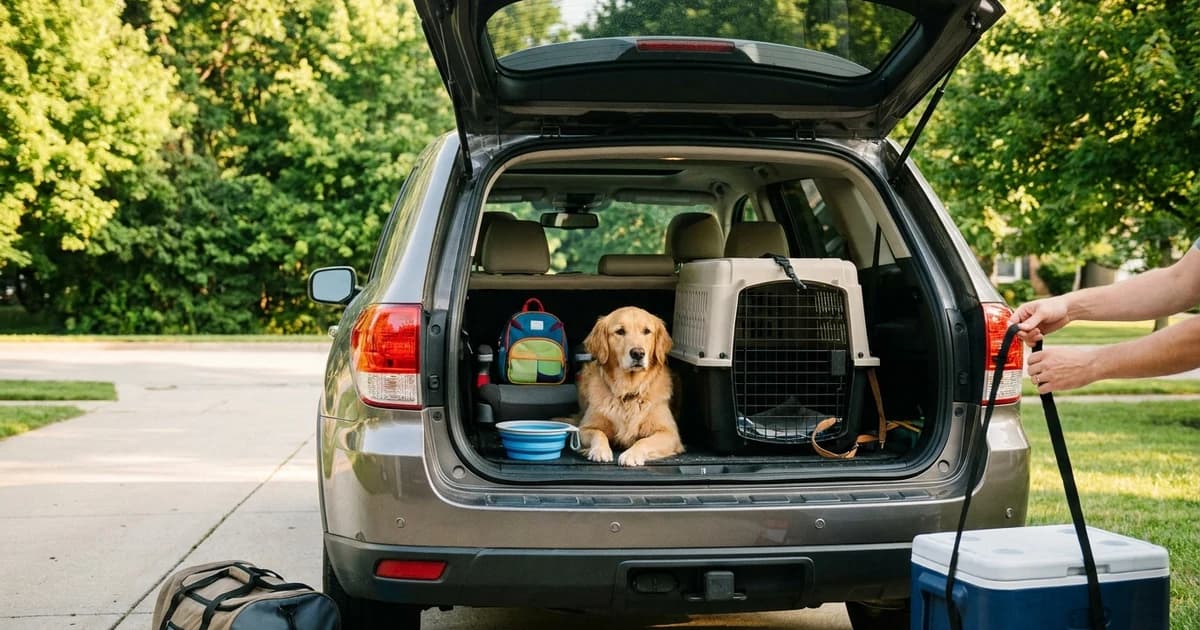
| Third row or cargo area | The dog, in a tethered harness or a crate strapped down so it cannot slide. Size the crate from your dog's measured length and height, not the breed label; this dog crate size calculator does the maths. | Restraint protects the dog in a hard stop and keeps them from becoming the driver's problem mid-highway. |
| Door pockets | Leash, waste bags, wipes. | The leash must be reachable before any door opens. This is the single most important placement in the car. |
For the restraint hardware itself, which harnesses actually hold in a crash, how to anchor a crate, and the heat math for parked cars, this dog road trip safety plan goes deeper on the dog side than we can here. Read it before you buy a harness based on a marketing photo.
2. One stop, two species: the cadence
Veterinary consensus is that the average dog needs a break from the car every 2 to 4 hours, and that those breaks should run at least 15 minutes. The AVMA's long-trip guidance lands at the tight end of that range: plan to stop every two hours so dogs can exercise and relieve themselves, wearing collar, tags, and leash the moment they leave the car. Conveniently, two hours is also about the limit for a potty-trained preschooler, so run one timer for the whole car.
The double-duty stop, in order:
- Leash clipped before any door opens. Rest stops sit next to highways, and an excited dog plus an open sliding door is how trips end early.
- Everybody potties. Dog first on the grass strip, kids inside. Splitting adults makes this a 10-minute stop instead of 25.
- Water both species from the same jug: bottles for kids, collapsible bowl for the dog.
- Five minutes of real movement. A fetch toss or a race to a light pole resets kids and dog alike for the next leg.
- Trash and crumb sweep before reloading, because every dropped goldfish cracker is a dog distraction at 70 mph.
The non-negotiable: never leave the dog alone in the parked car, even for a fast food run. Veterinary guidance flags anything above 70°F or below 35°F outside as a safety concern, and cabins heat far faster than parents expect. Run a split crew instead: one adult takes kids inside, one stays on the grass with the dog, then swap.
3. The double-duty packing matrix
This is where a kids-and-dog trip stops being double the packing. Most needs overlap, so pack the overlap once:
| Need | Kid version | Dog version | Double-duty move |
|---|---|---|---|
| Water | Spill-proof bottles | Collapsible bowl | One gallon jug in the cooler refills both all day. |
| Food | Cooler snacks, no-melt bin | Meals pre-measured into zip bags | One cooler, one shelf per species. Feed the dog a light meal 3 to 4 hours before departure, never in a moving car. |
| Mess kit | Wipes, spare outfit, grocery-bag trash liner | Waste bags, old towel | One caddy behind the driver's seat handles blowouts, mud, and carsickness for everyone. |
| Boredom | Our road trip games and snacks-and-activities rotation | One long-lasting chew, saved for the whiniest hour | Deploy both at the same time. A settled dog buys you a quiet audiobook stretch. |
| Comfort | Lovey and blanket | A familiar blanket or toy in the crate, which the AVMA notes helps pets settle | Wash neither the week before the trip. Familiar smell is the point. |
| Documents | Insurance cards, reservations | Vaccination records, current ID tags | One folder in the glovebox. Many hotels ask for vaccine records at check-in. |
4. Booking overnights and picking stops
Reverse the usual booking order: confirm the dog, then the kids. Every major booking site has a pets-allowed filter, but the filter does not show weight limits, breed rules, or fees, and all three vary wildly. Call the actual property and ask three questions: is there a weight limit, what is the pet fee per night, and can we get a ground-floor room near an exterior door. That last one turns 6 a.m. dog walks from an elevator expedition into a 90-second errand.
For the driving days, favor stops with grass over plazas: state welcome centers, town parks a few minutes off the interstate, and rest areas with pet exercise zones. If you are keeping the whole trip cheap, the math in our budget family vacation ideas guide still works with a dog, since road trips are already the budget pick and a pet fee is far cheaper than a week of boarding. More route ideas live in our family road trips hub.
Sources
- AVMA — Traveling with Your Pet FAQ (restraint, front-seat and lap warnings, two-hour stop guidance, never leave pets unattended, feeding before travel)
- Oak Grove Animal Hospital — Road Trip With Your Dog (vet consensus on breaks every 2 to 4 hours, 15-minute minimum, parked-car temperature thresholds)