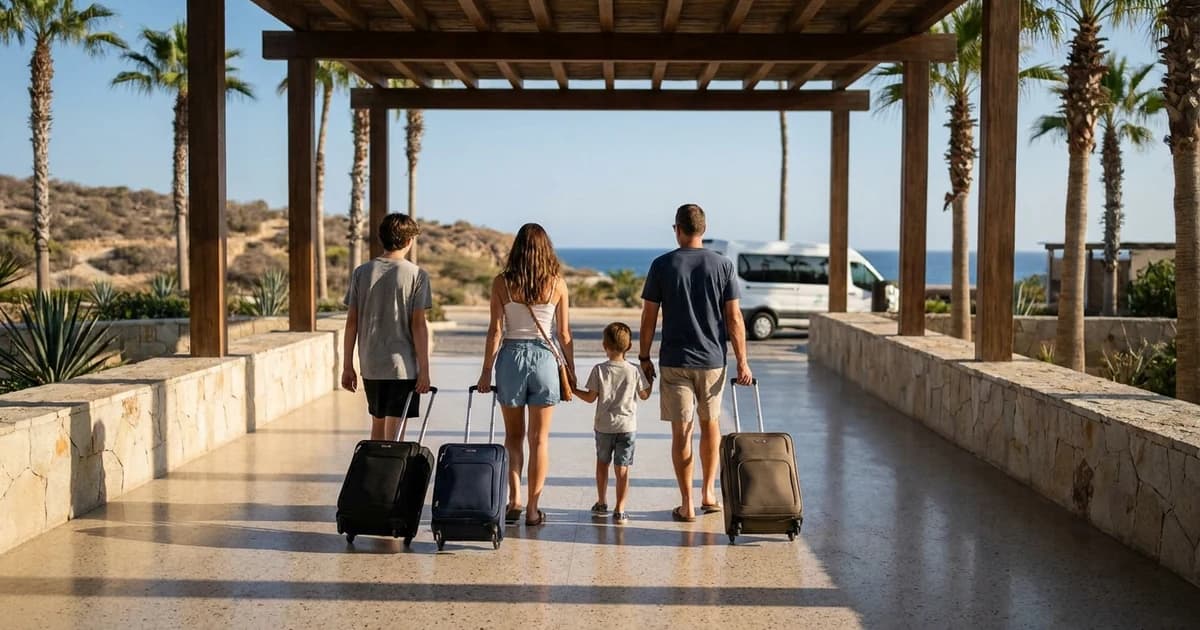
Two numbers decide a short international trip
Ask the internet for the shortest international flights out of LAX and you get a clean ranked list of block times, written mostly for aviation fans. The list is accurate. It is also the wrong number to book a family trip on. (For the wider map, including domestic, see our nonstop family destinations from LAX guide.)
Air time tells you how long the flight is. The clock shift tells you how long the trip is.
A two-and-a-half-hour flight that lands you on the same clock is genuinely a short trip: naps intact, bedtime intact, a real afternoon on arrival day. A four-hour flight that lands you three hours ahead is a time-zone move with a beach attached. Dinner runs late, the first morning starts in the dark, and the last day disappears into an early check-out. Both get filed under "short flight to Mexico." They are not the same trip.
Mexico stopped changing its clocks, California did not
This is the part most family-travel writing has not caught up with, and it changed recently enough that older guides are quietly wrong.
In October 2022 Mexico replaced its time rules with the Ley de los Husos Horarios en los Estados Unidos Mexicanos. Article 3 defines four zones — Centro, Pacífico, Noroeste and Sureste. Article 4 is the one that touches your itinerary: seasonal time now applies only to states and municipalities on the northern border. Everywhere a family actually flies for sun — Los Cabos, Puerto Vallarta, Cancún — sits on standard time all year.
California still changes. Under the federal rule NIST publishes, US daylight saving time runs from the second Sunday in March to the first Sunday in November — in 2026, March 8 to November 1.
So the gap between home and your resort is not fixed. It widens by an hour the moment California falls back, which is roughly when families start booking winter-break sun.
What time it will be when you land
Zones below come straight from the statute. The comparison is against Los Angeles.
| Where you land | Zone under the 2022 law | Ahead of LA, Mar–Nov | Ahead of LA, Nov–Mar |
|---|---|---|---|
| Los Cabos, La Paz, Loreto (Baja California Sur) | Pacífico (UTC−7) | Same time | 1 hour |
| Mazatlán (Sinaloa) | Pacífico (UTC−7) | Same time | 1 hour |
| Puerto Vallarta and Nuevo Vallarta | Centro (UTC−6) | 1 hour | 2 hours |
| Guadalajara, Mexico City | Centro (UTC−6) | 1 hour | 2 hours |
| Cancún, Playa del Carmen, Cozumel, Tulum (Quintana Roo) | Sureste (UTC−5) | 2 hours | 3 hours |
One oddity worth knowing if you are booking the Vallarta area: the law puts Nayarit in the Pacífico zone but carves out the municipality of Bahía de Banderas, which covers Nuevo Vallarta, and moves it onto Puerto Vallarta's Centro clock. Your resort and the airport agree; the rest of Nayarit is an hour behind.
Under three hours: Baja is a different category
Baja California Sur is the only part of the short-haul map where the clock does nothing to you between March and November, and costs a single hour the rest of the year. Mazatlán, across the water in Sinaloa, shares the zone.
What that actually buys a family:
- A usable arrival day. A morning departure has you at the pool by early afternoon, still on your own clock.
- A bedtime that holds. No 9 p.m.-that-is-really-7 p.m. standoff on night one.
- Short trips that are worth taking. Three or four nights is reasonable here. At a three-hour shift it usually is not.
What it does not buy you: warm, glassy Caribbean water, or kids' clubs at Cancún's scale. Baja's Pacific side has surf and current; the Sea of Cortés side is the calmer choice with small children. Our Cabo San Lucas guide has the beach-by-beach detail.
Cancún is a short flight and a long day
Quintana Roo is the only Mexican state in the Sureste zone, referred to the 75-degree meridian — effectively US East Coast time, with no seasonal change to soften it. Roughly four to four and a half hours in the air from LAX, then two or three hours forward.
What that looks like in practice, flying in winter:
- A 9 a.m. LAX departure lands late afternoon local, which is early afternoon to your kids' bodies. This is the good version.
- An afternoon departure lands after dark local, with a transfer to Playa del Carmen or Tulum still ahead of you. Budget a lost first night.
- Expect early wake-ups for the first two mornings. That is the shift, not the resort, and it resolves. Our toddler jet-lag guide covers the reset.
None of this argues against Cancún. It argues against booking Cancún for four nights. Cancún and the Riviera Maya repay six or seven. If you are weighing the two head to head, our Cancún vs Cabo comparison takes it apart on cost, water and kid-fit.
Four to six hours: where a short trip stops working
Past Mexico the map thins fast. Belize City and Costa Rica's Guanacaste coast are the realistic next nonstops from LAX, and they change the arithmetic in a second way: the ground transfer at the far end is frequently another hour or two by road, which no flight-time list shows you.
- Worth the distance when: you have seven nights or more, the kids are old enough to absorb a long transfer day, and the trip is built around one place.
- Not worth it when: it is a long weekend, there is a baby still on two naps, or the plan involves two bases inside six nights.
When the shortest flight is the wrong booking
| If this is your trip | Book this instead |
|---|---|
| Three or four nights, any age | Baja California Sur. At a two-hour shift you spend a quarter of a short trip adjusting. |
| You want calm, warm swimming water in January | Take the Quintana Roo clock hit and stay a full week. Baja's winter ocean is cool. |
| Baby under one, first flight | Shortest air time wins outright. Cabin time is the constraint, not the calendar. |
| Teens who sleep late anyway | Ignore the clock column. A two-hour shift eastward suits them fine. |
Passports do not get easier on a two-hour flight
A short flight is still an international flight, and the paperwork does not scale down with it.
The under-16 shortcut parents remember — a birth certificate instead of a passport — is real, but CBP confines it to land and sea crossings, where "U.S. and Canadian citizen children under the age of 16 … need only present a birth certificate or other proof of citizenship." Driving down to Tijuana, that applies. Flying to Los Cabos, it does not. Our guide to kids' travel documents covers renewal timelines, which is the part that actually strands families.