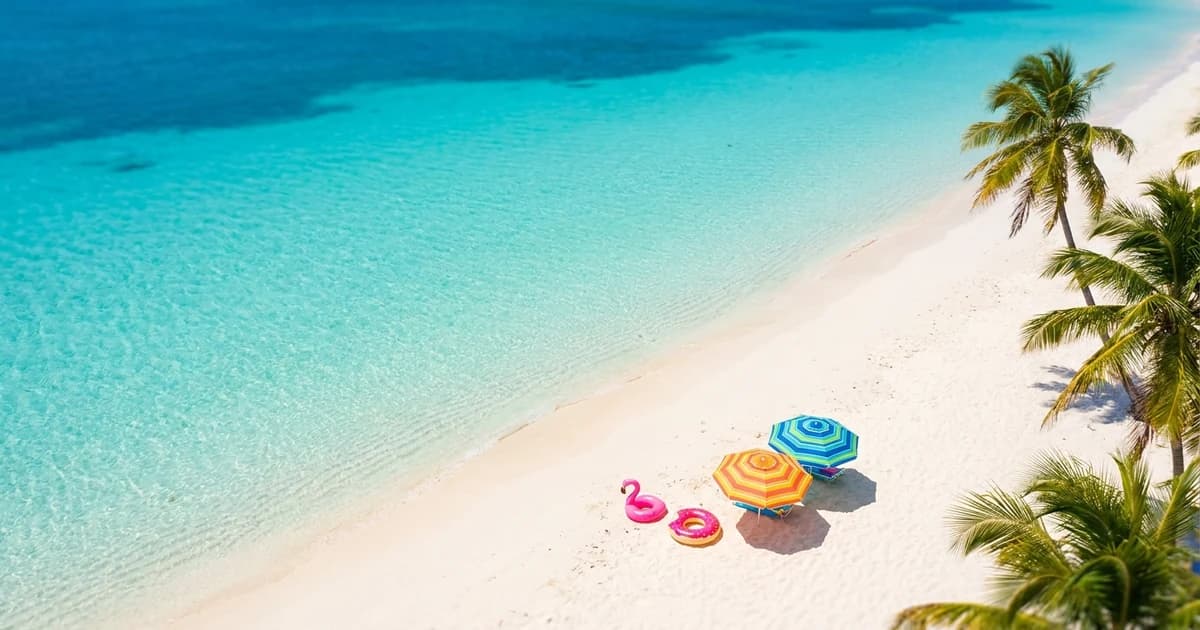
The short version: there is no single best Caribbean island for families. The right pick depends on three things most lists ignore together: how long a nonstop flight your kids can handle, whether you want a calm shallow beach or an adventure base, and your budget tier. Below is a by-island matrix that lines all three up, so you can match an island to your family instead of scrolling through ten generic rankings.
Quick answer: match the island to your family
- Youngest kids and shortest flight: Turks and Caicos or Grand Cayman. Calm, shallow, turquoise water and the closest nonstop hops from the US East Coast.
- No passport hassle: Puerto Rico (a US territory). US citizens can fly with a driver's license and spend US dollars.
- Year-round, weather-proof: Aruba, which sits south of the Atlantic hurricane belt.
- Best value: Punta Cana (Dominican Republic) and Jamaica, where family all-inclusives keep the per-night cost down.
- Older kids and teens who want to do, not just sit: Puerto Rico, Aruba, or St. Lucia for hikes, rainforest, water sports, and bioluminescent bays.
The family-fit matrix
Flight times below are approximate nonstop durations from the closest major US hubs (Miami for the western and northern Caribbean, the New York area for the southern islands). Actual times and prices vary by origin city and season. Use them as a relative ranking, not a booking quote, and always check live schedules and rates. Our Caribbean overview covers what the islands have in common before you narrow down.
| Island | Nonstop flight (approx.) | Beach style | Best age band | Budget tier |
|---|---|---|---|---|
| Turks and Caicos | ~1h45 from Miami | Very calm, shallow (Grace Bay) | Babies to school-age | $$$ |
| Grand Cayman | ~1h50 from Miami | Calm (Seven Mile Beach) | Toddlers to tweens | $$$ |
| Bahamas (Nassau) | ~1 to 3h from East Coast | Calm, resort-heavy | All ages | $$ to $$$ |
| Punta Cana (DR) | ~2h from Miami | Calm in resort coves | All ages | $ to $$ |
| Jamaica | ~3h45 from NYC area | Calm to lively, varies by coast | School-age and up | $ to $$ |
| Puerto Rico | ~3h50 from NYC area | Mixed: calm bays + surf | School-age, tween, teen | $$ |
| Aruba | ~4h30 from NYC area | Calm leeward beaches, breezy | All ages, esp. tween/teen | $$ to $$$ |
| St. Lucia | ~4h30 from NYC area | Adventure-first, scenic | Tween, teen, multi-gen | $$$ |
Budget tiers are a rough peak-season feel: $ = value-friendly, $$ = mid-range, $$$ = premium. All-inclusive pricing shifts these a lot.
What most lists get wrong
Generic rankings treat "best for families" as one thing. It isn't. A family flying with a 14-month-old wants the shortest possible flight and a wave-free lagoon, which points hard at Turks and Caicos or Grand Cayman. A family with two teenagers wants something to climb, paddle, or zipline, which points to Puerto Rico, Aruba, or St. Lucia, even though those are longer flights. The same island can be the best and worst pick depending on who is in your row. Pick the column that matters most to your family first, then read across.
The calm-water islands (babies and toddlers)
Turks and Caicos is the gentlest entry point. Grace Bay is famous for shallow, glass-calm turquoise water and a wide soft beach, which is exactly what you want with a child who can barely walk. It is also one of the shortest nonstop hops, roughly an hour and forty-five minutes from Miami.
Grand Cayman pairs the calm of Seven Mile Beach with low-key wildlife outings that toddlers and tweens both love: Stingray City is a shallow sandbar where you stand waist-deep, and the turtle center is a controlled, kid-friendly experience. Flight time is similar to Turks, around an hour and fifty minutes from Miami.
For a deeper toddler-specific breakdown, see our guide to the best beach destinations for toddlers.
The no-passport and weather-proof picks
Puerto Rico is the practical winner for nervous first-timers. As a US territory, US citizens do not need a passport, you spend US dollars, and your phone usually works on a domestic plan. It is also more of an adventure island than a single-beach resort: rainforest, a historic old town in San Juan, and bioluminescent bays for older kids. That makes it a strong school-age-and-up choice rather than a baby beach.
Aruba solves the other big family worry: weather. It sits south of the Atlantic hurricane belt, so the late-summer storm risk that hangs over most of the Caribbean is much lower there year-round. The leeward beaches are calm and the island is set up for variety, from a butterfly farm to a national park, which travels well across ages.
The value islands (stretch your budget)
Punta Cana in the Dominican Republic and Jamaica are where family all-inclusives keep the math friendly. Resort coves are calm, kids clubs are standard, and packaging flights, rooms, food, and activities together often beats paying a la carte. Punta Cana is also a quick roughly two-hour nonstop from Miami, and the Punta Cana itinerary for school-age kids shows how a week off the resort fills up. If an all-inclusive is your plan, our roundup of the best all-inclusive resorts for families goes deeper on specific properties.
How to use flight time as your first filter
For families, flight length is usually the real constraint, not the island. A good rule: the younger the child, the more a sub-two-hour nonstop matters, because a meltdown at hour one of a six-hour day is very different from a meltdown at hour four. If your kids are school-age or older and travel well, the longer southern-Caribbean flights open up the most variety. Before you book, read up on the best time of year to travel with kids and how to handle the journey itself with our long-flight survival tips.
When to go
December through April is the dry, calm-sea high season across most of the Caribbean. The Atlantic hurricane season officially runs June 1 to November 30, with the peak around September 10 and most activity between mid-August and mid-October, per the National Hurricane Center. If you must travel in that window, Aruba and the other ABC islands carry the lowest storm risk because they sit outside the belt. For the wider tradeoff, compare a European vs Caribbean family beach trip or weigh Hawaii vs the Caribbean with a toddler.
Sources
- National Hurricane Center, NOAA, Atlantic hurricane season climatology (season dates and peak): nhc.noaa.gov/climo
- Discover Puerto Rico (official destination marketing organization), no-passport travel for US citizens: discoverpuertorico.com
- U.S. News Travel, Best Caribbean Family Vacations rankings: travel.usnews.com