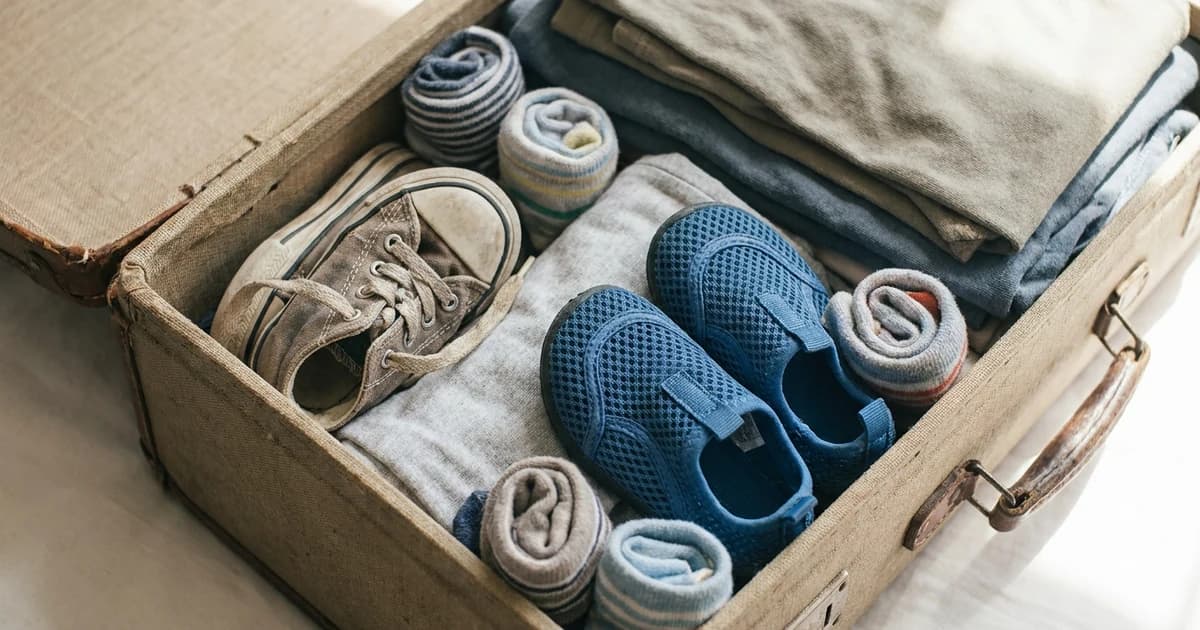
Shoes are the quiet villain of family packing
Clothes squish. Toiletries shrink into a pouch. Shoes do neither — they are rigid, they take up a whole corner of the suitcase, and a kid will outgrow or destroy a pair on the trip itself. So families overpack them out of fear: a pair for the beach, a pair for hiking, a pair for the nice dinner, a backup in case one gets soaked. Four pairs per kid times three kids and you have lost a checked bag to footwear alone.
The fix is not packing fewer random shoes. It is packing shoes that each cover more than one job, choosing them by what the trip actually involves, and refusing to bring the one category that wrecks the most vacation days: the brand-new pair.
Key takeaways
- Two pairs per kid covers most trips. One closed, broken-in everyday shoe they wear on the plane or in the car, plus one water-friendly pair. A third only if there's a real reason (formal dinner, real hiking).
- Never pack brand-new shoes. New shoes that haven't been broken in are the single biggest cause of travel-day blisters — friction from an unworn shoe shows up on day one, miles from home.
- Wear the bulkiest pair, pack the rest. The heaviest shoes go on feet during transit, not in the bag.
- Fit matters more on a trip than at home. Kids walk far more on vacation than on a normal day, so a slightly-too-small shoe you tolerate at home becomes a meltdown by lunch.
The two-bag rule: one on the feet, one in the bag
Here is the whole strategy in a sentence: each kid travels in their everyday closed shoe and packs exactly one more pair that handles water. That covers the airport, the city walking, the playground, the beach, the pool, and the inevitable splash pad — with two pairs.
The everyday shoe is a familiar sneaker or closed walking shoe the child already wears and likes. It goes on their feet for the flight or drive (so it isn't eating suitcase space) and does all the dry-land walking at the destination. The second pair is the one most families get wrong by leaving home: a water shoe.
| What to bring | What it covers |
|---|---|
| Everyday closed sneaker (worn in transit) | Airport, plane, car, city walking, theme parks, museums, playgrounds. The workhorse pair — already broken in, already loved. |
| kids’ quick-dry water shoes | Beach, pool, splash pad, hotel shower, rocky lake bottom, boat decks. Quick-dry so they aren't a soggy brick in the bag; closed-toe so hot sand and pool-deck grime don't hurt. |
| (Optional) one dressy or activity pair | Only if the trip has a genuine reason — a formal dinner, a wedding, or a real trail hike. If there's no reason, leave it home. |
Water shoes punch above their weight precisely because they erase the third and fourth pairs families used to pack. They replace flip-flops (which fall off toddlers and offer zero protection), they handle the hotel-pool deck and the gross shower floor, and they let a kid scramble over tide pools or a rocky lakebed without the day ending in a cut foot. Closed-toe, quick-drying pairs like these lightweight aqua socks weigh almost nothing and don't soak the rest of your bag.
Match the shoes to the trip, not to a generic checklist
A printable list that says "sneakers, sandals, water shoes, dress shoes" makes everyone pack all four every time. Instead, ask one question — what does this trip mostly involve? — and pack to that.
| Trip type | Per-kid footwear plan |
|---|---|
| Beach or resort | Everyday sneaker (worn in transit) + water shoes. That's it. Skip the dress shoes — resort dinners are casual. |
| City sightseeing | Two broken-in walking pairs if it's a long trip, because city days mean miles on pavement and one pair will get rained on. Water shoes only if there's a hotel pool. |
| Theme parks | The most supportive, most broken-in closed sneaker you own, full stop. This is not the place to debut anything. Pack a spare pair of socks per day instead of a spare pair of shoes. |
| Nature / cabin | Closed sneaker or a real trail shoe for hikes + water shoes for the lake. Add an old pair you don't mind getting muddy if there's mud. |
| Cold-weather trip | One warm waterproof boot (worn in transit) + the everyday sneaker for indoors. Boots are the bulkiest thing you own — they always go on feet, never in the bag. |
The mistake that ruins day one: brand-new shoes
The most common footwear error isn't packing too many — it's packing a shiny new pair bought specifically for the trip. It feels responsible. It's a trap.
Unworn shoes haven't molded to a child's foot, so they create friction in exactly the spots that cause blisters — and a vacation is the worst possible time to discover that. Cleveland Clinic's guidance on avoiding blisters is blunt: wear properly fitted shoes, break them in ahead of time, and pair them with moisture-wicking socks rather than all-cotton, which traps sweat and makes rubbing worse. Shoes that are even slightly too big or too small add friction on their own. On a normal day a new shoe causes one sore heel; on a 12,000-step vacation day it ends the afternoon.
If a child genuinely needs a new pair for the trip, buy it two to three weeks early and have them wear it around the house and on short walks first. By departure day it should already feel like an old shoe.
How to know a kid's shoe actually fits
Kids walk dramatically more on vacation than at home, which is exactly why a borderline fit you've been ignoring becomes a problem on the road. Two quick checks before anything goes in the bag:
- Thumb-width of room at the toe. The American Academy of Pediatrics' guidance for active kids is that the top of the big toe should sit about a finger-width from the front edge of the shoe — and that it's better to have no shoes at all than shoes that are too tight. Check the fit on the foot that's standing, since feet spread under weight.
- Comfortable immediately, with socks. The American Podiatric Medical Association is clear that a child's shoe should feel comfortable right away — there's no "they'll get used to it." Try it on with the socks they'll actually wear, and always fit to the larger foot, since feet are rarely the same size.
Two more APMA notes worth packing in your head: kids' feet change every few months, so the size that fit last summer may not fit this one — measure before you trust it. And resist the hand-me-down for a trip; beyond the fit problem, sharing shoes can spread athlete's foot and nail fungus, which a shared hotel-pool deck does plenty of on its own.
The packing logistics that keep it light
- Wear the heaviest pair in transit. Boots and bulky sneakers go on feet at the airport, not in the suitcase.
- Stuff socks and small items inside packed shoes. The shoe's hollow is dead space — fill it.
- Bag the packed pair. A cheap drawstring or even a grocery bag keeps yesterday's sole grime off clean clothes, and contains a still-damp water shoe.
- Pack extra socks, not extra shoes. Fresh, dry, moisture-wicking socks midday do more for comfort than a whole second pair of shoes, and weigh a fraction as much.
One more thing: feet get tired before kids admit it
Even with perfect shoes, vacation days are long, and a worn-out kid is a footwear problem in disguise. Build in real sit-down breaks — a shaded bench, the hotel room after lunch, a slow restaurant meal — and have one quiet activity on hand for those resets. A compact build set like the LEGO Creator 3-in-1 Cute Bunny set is good for exactly this: it gives feet an hour off while small hands stay busy, and it packs flat. The goal of all of it — the right shoes, the breaks, the dry socks — is the same: keep everyone walking happily, because the trip happens on foot.
Sources
- American Academy of Pediatrics (HealthyChildren.org) — Shoes for Active Toddlers (fit check, nonskid soles, "better no shoes than too-tight")
- American Podiatric Medical Association — Helpful Kids' Shoe Shopping Tips (comfortable immediately, fit larger foot, never hand down, measure before buying)
- Cleveland Clinic — 5 Ways To Avoid Blisters (break in new shoes ahead of time, fit + moisture-wicking socks reduce friction)