The quick version
The EES is already live. Unlike ETIAS (which still hasn't launched), the EU's biometric Entry/Exit System began rolling out on 12 October 2025 and, as of 10 April 2026, has replaced the old inked passport stamp with an electronic record of every entry and exit. So if you're taking the family to Europe this year, the first time you reach passport control everyone gets registered — and there are a few age-specific quirks worth knowing before you're standing in line with a tired toddler.
This is a researched explainer built from official EU sources, not border advice we tested in person. The rollout is still uneven, so we flag what's confirmed versus what varies by crossing. For the separate travel-authorization question, see our companion guide, Do You Need ETIAS to Visit Europe in 2026?, or run the Do I need ETIAS? checker.
Key takeaways
- EES is not ETIAS. EES is a biometric check that happens at the border and is live now. ETIAS is an online authorization you apply for in advance, expected late 2026.
- Every family member is registered — babies included — the first time you cross into the Schengen area.
- Kids under 12 don't give fingerprints, but they are not exempt from the system: they're still photographed and logged.
- It's a one-time enrolment. Once your family's biometrics are on file, later trips within the retention window just verify against the record.
What the EES actually is (and isn't)
The Entry/Exit System is an electronic register that records non-EU visitors each time they enter or leave 29 European countries — the 25 EU states in the Schengen area (everyone except Cyprus and Ireland) plus Norway, Iceland, Switzerland and Liechtenstein. It captures your passport details, a facial image, fingerprints (for most adults), and the date and place of each entry and exit.
The point is to automate the 90-days-in-any-180 rule. Manual passport stamping was abolished on 10 April 2026, and an automated calculator now tracks how many of your 90 days you've used across the whole zone as a single shared pool. The stamp collection is gone; the math is done for you — and against you if you overstay.
| EES | ETIAS | |
|---|---|---|
| What it is | Biometric entry/exit record | Pre-trip travel authorization |
| Where it happens | At the border booth or kiosk | Online, before you fly |
| Status in 2026 | Live, still rolling out | Not yet launched (expected late 2026) |
| Cost | Free | €20 (under-18s exempt from the fee) |
| Kids | Registered; under-12s skip fingerprints | Under-18s exempt from the fee |
What happens at the border, age by age
Here's what each visa-exempt traveler (US, UK, Canadian, Australian and similar passports) does the first time the family crosses in under the live system:
| Traveler | Facial photo | Fingerprints | Counts toward 90/180 | Must be present |
|---|---|---|---|---|
| Baby / child under 12 | Yes | No (exempt) | Yes | Yes |
| Age 12–17 | Yes | Yes (4 fingers) | Yes | Yes |
| Adult | Yes | Yes (4 fingers) | Yes | Yes |
On later trips within the data-retention window (records are normally kept for three years after your last visit), you're not re-enrolled from scratch — the booth simply checks your face and fingerprints against the stored record. Visa-required nationalities are a different case: they only give a facial image at EES, because their fingerprints were already taken with the visa.
The under-12 rule — and the trap in it
The most common myth we see is that children under 12 are “exempt from the EES.” They're not. The exemption is narrow: under-12s skip the fingerprint scan, but they are still enrolled — passport data plus a facial photo — and their days still count toward the family's 90/180 allowance. In the EU's own words, their fingerprints “are not scanned, even if they are subject to the EES.”
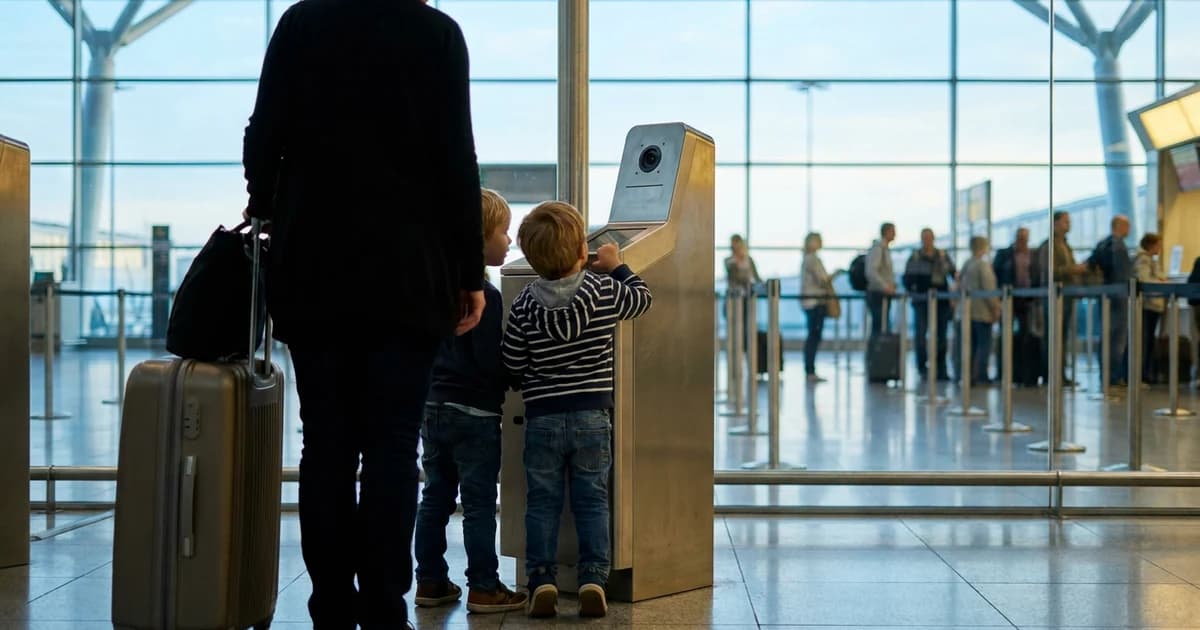
The practical upshot: don't assume you can breeze a sleeping infant through in a carrier without stopping. The whole family has to be present and processed, each child needs their own valid passport, and a facial capture on a wriggly toddler is exactly the step most likely to slow your lane down. Budget for it rather than being surprised by it.
Summer 2026 reality: expect uneven lines
Honest caveat: EES was not fully switched on at every Schengen crossing by the 10 April 2026 target, and the European Commission has given border posts “built-in flexibility” to suspend EES for short windows (up to six hours) when queues get excessive. In early May 2026 the Commission said the system was “functioning normally” at most crossings, but the experience genuinely varies by airport, by day, and by how many first-time enrolments are in front of you.
So the take-home isn't “panic” — it's “pad your first arrival.” If you've got a tight connection or a car-seat installation and a hotel check-in waiting on the other side, give yourself a wider buffer than you would have pre-EES.
How to move the family through faster
- Buffer your first arrival. The enrolment is one-time, but it's slowest on trip one, especially with kids. Add time before any onward connection.
- Carry biometric (chipped) passports where you can. They're required to use the faster self-service kiosks; without one, you're routed to a staffed booth. Manned booths still accept non-biometric passports.
- Pre-register if the option exists. Frontex's voluntary “Travel to Europe” app lets you complete part of the registration ahead of time, though fingerprints are still taken at the border and it's only live at a handful of crossings so far.
- Brief the 12-and-ups. Older kids give four fingerprints and a photo just like adults — a 20-second heads-up avoids the confused-at-the-kiosk moment.
- Keep everyone together. Every member of the party must be present for their own record; you can't register the kids on a parent's passport.
One nuance for mixed-nationality families
If a non-EU parent or child is traveling with an EU or Schengen citizen exercising free movement, they can be registered as a “family member,” which carries reduced data-retention rules and skips the automated 90/180 calculator. That's a specific legal status, not a general perk for everyone traveling as a group — an all-American or all-British family is logged as regular travelers.
Planning that first European trip around the new checks? A slower-paced base city helps — think a few unhurried days in Madrid or a toddler-paced Barcelona itinerary — and make sure every child has their own passport long before you reach the kiosk.